Post-Quantum Blockchain Security for AI-Powered Web3 Applications in Brisbane
Explore post-quantum blockchain security in Brisbane for AI-powered Web3 applications, including ML-DSA signatures, wallet security, and ARMChain.
Roohan Adeel
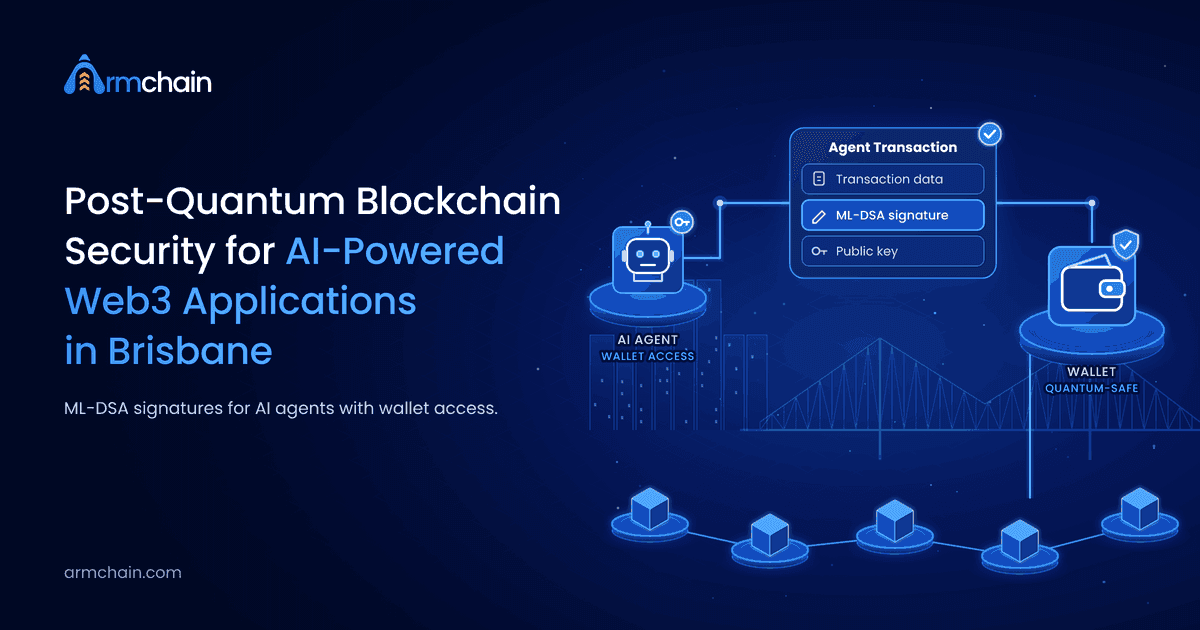
Explore post-quantum blockchain security in Brisbane for AI-powered Web3 applications, including ML-DSA signatures, wallet security, and ARMChain.
Roohan Adeel
An AI agent with access to a crypto wallet can do more than read a balance. Depending on the permissions it gets, it can swap tokens, call a contract, or move assets between accounts. Anyone building that product has to answer two questions. What is the agent allowed to do? And what stops someone else from signing as that account?
The second question is about cryptography, and it is where post-quantum blockchain security in Brisbane becomes relevant for any team building agent-driven products meant to run for years. Many chains still sign transactions with elliptic curve signatures, and a future quantum computer could break them. A product launched this year may still be holding wallets in 2035.
The link between AI and blockchain is practical already. A trading agent watches market data and prepares a swap. A lending app uses an agent to watch positions and warn before a liquidation. An assistant carries out approved payments through a contract. In each case, the agent decides or recommends, and the wallet and chain carry out the transaction. Those two jobs have to stay apart. An agent should not be able to move funds just because it produced a confident instruction or read something unexpected.
Take an agent built for small, routine payments. It has no reason to touch every asset in the account, or to call any contract it happens to find. Content is a risk too. An agent that reads a web page or a PDF can pick up instructions planted there to steer it. This is known as prompt injection. Those instructions must not be able to override the rules on the wallet.
So the limits belong in the wallet, not in the model. A daily spending cap, a list of approved contract addresses, and a manual sign-off above a set amount only work if the wallet enforces them. A model that follows its instructions most of the time is not a control. Behind approval sits one more layer: the signature itself.
Bitcoin and Ethereum sign transactions with ECDSA, a form of elliptic curve cryptography, and other chains use related curves such as Ed25519. On today's computers, working out a private key from a public key is not feasible. On a large enough quantum computer, Shor's algorithm could break the mathematical assumptions behind these systems.
A blockchain account is a key pair. The private key signs, and the public key lets others check the signature. An attacker who can derive the private key from the public key can sign as the account. On Ethereum, the public key becomes visible once the account sends its first transaction.
An agent using that wallet inherits the problem. Its code could be flawless and the account behind it still untrustworthy. None of this lets anyone read an AI model or pull out its training data. Prompt injection, private datasets, and model behaviour need their own controls. Post-quantum signatures deal with a different question: did the transaction really come from the account claiming to have signed it?
Post-quantum cryptography (PQC) replaces algorithms that a quantum computer could break. NIST published its first PQC standards in August 2024. For digital signatures, the relevant standard is ML-DSA (FIPS 204). It is built on lattice problems, a different mathematical foundation from elliptic curves.
ML-DSA blockchain transactions use this signature approach to authenticate operations without relying on conventional elliptic curve methods. ML-DSA does not protect private prompts or secure a model while it processes data. A business running confidential AI workloads still needs a trusted execution environment (TEE), encrypted data, and tight access controls across its systems.
Those safeguards deal with AI data and processing. PQC has a narrower job in a Web3 application: keeping transaction signatures secure as quantum computing develops.
ARMChain is an EVM-compatible blockchain with post-quantum cryptography at its core. Accounts and validators sign with ML-DSA-44, and nodes connect over ML-KEM-768, the key-encapsulation algorithm specified in NIST FIPS 203. Smart contracts can verify ML-DSA signatures too, through a precompile at address 0x0100. A smart account can therefore check who is calling without falling back to ECDSA.
The technical details are covered in the ARMChain whitepaper. No asset, validator, or node depends on a public-key problem a quantum computer can solve, unless the owner chooses a classical scheme for compatibility. Accounts using standard Ethereum transaction types are, in the whitepaper's words, "exactly as exposed as on Ethereum."
There are also important development-stage details. ARMChain is currently on a devnet. A public testnet is targeted for 15 November 2026, and no external security audit has been completed yet. These details matter when businesses assess the network for a production application. You can also review the network's post-quantum security architecture.
ARMChain has native Account Abstraction. With a type-4 transaction, the account's own code decides whether the transaction is authorised. For an AI product, this lets the permission rules live in the account. An agent could handle routine payments, for example, while a larger transfer needs a second approval.
An account can validate using ML-DSA-44, SLH-DSA, a hybrid of ECDSA and ML-DSA that requires both signatures, a passkey, or a guardian set with M-of-N signing. ARMChain's validation scheme documentation explains how these options work.
Not every option offers the same level of quantum protection. Passkeys use the P-256 curve found in phones and security keys, while the first guardian design uses secp256k1. Both rely on classical cryptography. A passkey account may be convenient, but it is not quantum-safe. For an agent account intended to remain secure against quantum threats, ML-DSA, SLH-DSA, or the hybrid option is the relevant choice.
Cost is worth checking before designing around it. On the devnet, a self-paid ML-DSA smart-account transfer measured 163,730 gas. Most of that came from reading the 1,312-byte public key back from storage. The foundation's paymaster sponsors an account's first transaction, so a new agent account does not need tokens to be created.
Account Abstraction decides how rules are enforced. It does not decide which rules make sense. That remains the application's job, and an agent is not safe by default.
Developers can write Solidity as usual. Signing is where the workflow differs. Ethereum uses transaction types 3 and 4 for blobs and set-code, so generic Ethereum libraries can misread ARMChain's post-quantum transaction types. The ARMChain Ethers SDK documentation explains the signing workflow and the tools developers need.
Existing Ethereum signing flows will not work unchanged. Teams need to account for this when connecting wallets, smart contracts, and agent workflows. ARMChain handles the blockchain layer only. It does not host AI models or provide GPU compute. The AI processing runs separately from the transactions and contracts handled by the network.
For teams in Brisbane and Fortitude Valley, post-quantum blockchain security in Brisbane should be part of the wallet review from the start. It is also an important consideration for businesses assessing Quantum-Safe Blockchain in Queensland and planning their wider Web3 Security in Brisbane requirements.
Before deployment, check the following:
No. PQC deals with cryptographic operations such as transaction signing. A model's private data and the environment in which it runs need separate safeguards, depending on how the application handles that information.
It gives a blockchain account a post-quantum way to sign transactions. The agent uses that account to request permitted actions, and the network checks the signature against the account's validation rules.
No. ARMChain is a quantum-resistant blockchain at Layer 1, not a GPU hosting or model-training service. It provides the blockchain infrastructure for applications that need post-quantum transaction signing.
A product built today may still be handling wallets and digital assets years from now. Choosing a suitable signature scheme at the start is easier than changing the cryptography after it has spread across the product.